The real problem interior teams face before anything is rendered
Most interior projects don’t go sideways because the design is bad. They go sideways because people can’t see the same thing.
You’ve probably seen this play out:
- The client looks at a floor plan and nods. But they don’t really get it.
- The designer has a clear picture in their head. The owner has a different one.
- The GC reads the drawings “correctly”, but still makes choices the team didn’t expect.
Then approvals drag. Revisions stack up. And the project starts leaking time and money.
Interior work is also full of small decisions that add up. Paint looks fine on a sample card, but wrong on a full wall. A pendant light feels “too big” only after it’s installed. A layout looks efficient on paper, but the space feels tight once furniture is in.
So people decide based on guesswork.
That’s why “make it look right” turns into a loop:
concept → comments → changes → more comments → more changes.
And it’s not because anyone is difficult. It’s because the team is trying to approve a real space using tools that don’t show a real space.
What 3D interior rendering actually is (in real project terms)
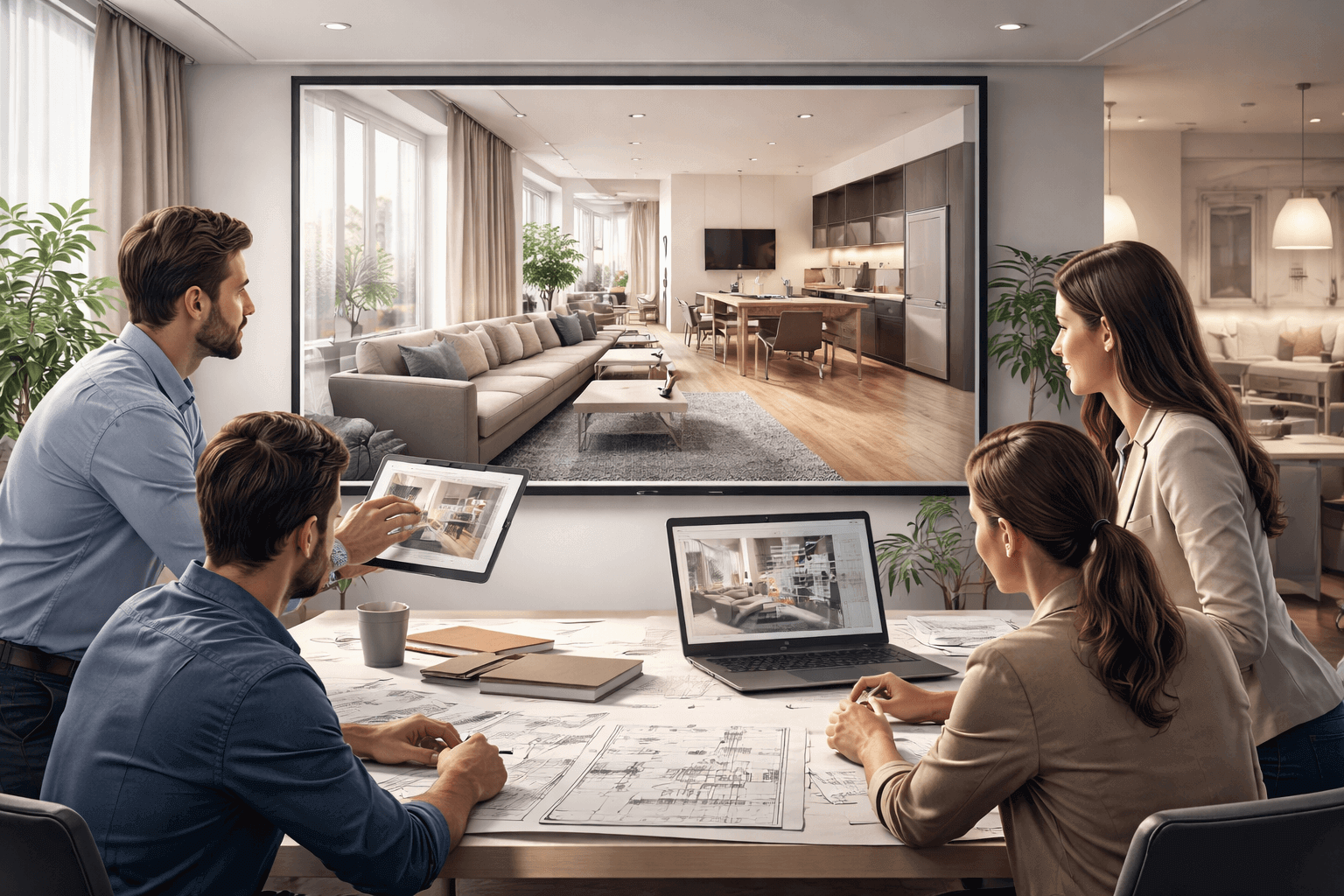
3D interior rendering is a realistic image of a space that hasn’t been built or finished yet. It’s created from your drawings, 3D model, specs, and design intent.
But it’s not just a “pretty picture”.
A good render does two practical jobs:
- It gives everyone the same reference point.
- It turns “i think” into “this is what we’re approving”.
That’s why teams use 3D Interior Rendering Services when approvals matter, budgets are tight, or the timeline can’t take endless revision rounds.
Here’s what usually goes in, and what you get out:
| Input (what you provide) | Output (what you get) |
|---|---|
| Floor plan / CAD / Revit + key dimensions | A realistic view that matches the layout |
| Material and finish specs (or references) | Surfaces that read like real materials |
| Lighting intent (fixtures, mood, time of day) | Lighting that supports the design, not fights it |
| FF&E list or direction (brands not required) | Furniture and decor that fit the style and scale |
| Camera angles / priority areas | Images focused on what stakeholders must approve |
A render is only as good as the decisions behind it. If the model is off, the scale will look wrong. If materials are vague, the result will feel generic. If lighting is guessed, the space won’t read the way it will in real life.
So the real value isn’t “realism”. It’s alignment.
Where interior rendering is actually used in real design workflows
People often assume interior rendering is only for designers. In the US, it’s used across design, development, and marketing because it makes decisions faster.
Residential interiors
This is common for custom homes, remodels, and multi-family amenities.
Use it when the homeowner is approving:
- layout changes
- kitchen and bath finishes
- built-ins and millwork
- lighting style and placement
It cuts the “i didn’t imagine it like that” problem.
Commercial and hospitality spaces
Restaurants, offices, clinics, retail, hotels.
Here the render is often part of:
- stakeholder alignment (owners, operators, brand teams)
- city or landlord discussions (when visuals help explain intent)
- contractor pricing (when scope needs to be clear)
It’s also where scale mistakes get expensive fast.
Real estate marketing
Leasing teams and brokers use renders when:
- the space isn’t finished
- the fit-out is planned but not built
- you need pre-leasing or pre-sales assets
It’s not about decoration. It’s about helping buyers and tenants understand what they’re getting.
Design approvals and investor decks
This is the “no ambiguity” use case.
Renders help when you need:
- faster sign-off
- fewer revision rounds
- clear communication in a deck or update
- visuals that match the business story (not just the design story)
If the decision-maker is not a designer, a render is often the only format that works.
How interior rendering fits into the full rendering production pipeline
A lot of people think interior rendering is the same as “make a nice image”.
In practice, it sits inside a chain. If one step is weak, everything after it looks wrong.
Here’s the typical pipeline for an interior project:
- Inputs and scope
You confirm what’s being shown and what “done” means.
How many views. What rooms? What style references. What level of detail.
This is where most issues start if it’s vague. - Base model and layout check
The scene needs correct dimensions. Doors, ceiling heights, window sizes, clearances.
If the model is off by even a little, furniture looks wrong and the space feels “fake”. - Lighting setup
Interior lighting is not just “add a sun”.
You need a clear intent: daytime vs evening, natural light direction, fixture types, light temperature.
Otherwise the render may look bright, but not believable. - Materials and finishes
This is where many cheap renders break.
The wood grain scale is wrong. Stone looks like plastic. Walls reflect like glass.
Materials have real behavior. A render has to match it. - Set dressing (FF&E)
Furniture, decor, and objects are not just “make it cozy”.
They define scale, circulation, and how the space reads.
Bad choices here can make a correct design look like a bad one. - Camera and composition
A camera angle can make a space feel bigger than it is. Or smaller.
It can hide what matters. Or show it clearly.
That’s why a render should follow the decision you’re trying to get. - Review and controlled revisions
Professional work isn’t “unlimited changes”.
It’s structured feedback rounds with clear targets.
This is why teams often choose a 3d rendering company instead of a solo generalist when the stakes are real. Not because “company = better”. But because production needs control. Someone has to own the process, QA, and consistency across views.
And no, you usually can’t “just do it fast” without cutting something from that chain.
Speed is possible, but only if inputs are clean and decisions are already made.
Interior rendering vs interior visualization vs 3D modeling
People use these terms interchangeably. That’s normal. But they are not the same thing.
And if you’re hiring, mixing them up leads to wrong expectations.
Here’s a simple breakdown:
| Term | What it means | What clients often assume |
|---|---|---|
| 3D modeling | Building the geometry: walls, ceilings, furniture, objects | “The final image is basically done” |
| Interior visualization | A broad term: any visual that helps understand the interior (could be stylized or realistic) | “It will look photoreal by default” |
| 3D interior rendering | The final output image with lighting, materials, camera, and post-production | “It’s just pressing render” |
A useful rule:
- If you only have modeling, you can still have a scene that looks flat or unfinished.
- If you have rendering, you’re paying for realism and decision-ready visuals.
If someone quotes you only for “modeling” and you expect photoreal images, that’s a mismatch.
If someone quotes “visualization” without defining the realism level, that’s also a risk.
What separates professional interior renders from cheap visuals
Cheap interior renders often look “fine” at first glance. Then you notice the problems.
And once you see them, clients and stakeholders see them too.
A professional result usually comes down to a few things.
Lighting that makes sense
Not just bright. Not just dramatic.
Real interiors have mixed light sources and soft transitions.
Bad lighting makes the space feel staged or empty.
Scale that feels human
Chairs look too small. Countertops too high. Rugs too big.
These errors often come from rushed modeling or random asset libraries.
Materials that behave like real materials
Paint doesn’t reflect like polished stone.
Brushed metal doesn’t look like chrome.
Wood grain has a real scale. Same for tile patterns.
If these details are wrong, the whole render feels fake.
Camera choices that match the goal
Wide angles can help show layout. They can also distort space.
A pro chooses angles that support approvals and reduce confusion.
Consistency across views
This matters when you have 6–12 images in a set.
Cheap work often looks like different projects from one view to another.
This is why buyers should compare 3d rendering services by scope and process, not by a single sample image.
A good portfolio shot can be a one-off. A reliable service shows consistency across a full interior set: same quality, same intent, same level of finish.
How interior rendering impacts budgets, approvals, and timelines
Interior renders don’t “save money” by magic. They save money when they prevent wrong decisions.
Most budget pain in interiors comes from three things:
- late changes (after pricing or after ordering)
- miscommunication (client approved “something else”)
- rework (field fixes, re-selection, redesign)
A good render helps earlier in the process, when changes are still cheap.
Here’s where it has real impact:
- Fewer approval loops. People stop debating in circles because they’re looking at the same thing.
- Cleaner pricing. Contractors can price with less uncertainty when scope and finishes are clear.
- Fewer “surprises” on site. Layout issues, scale problems, and awkward clearances show up before install day.
- Faster decisions on materials. Stakeholders can compare options in context, not on a tiny sample.
It also helps teams avoid “over-designing”. Sometimes the render shows that a simpler approach works. Or that a feature looks good on paper but doesn’t add value in the space.
One important note: a render is not a replacement for construction documents. It’s not an engineering deliverable. But it’s a strong decision tool. And decision speed is usually the real schedule problem.
When interior rendering becomes a must-have, not a nice-to-have
Sometimes you can get by with mood boards and 2D drawings. Sometimes you can’t.
Interior rendering becomes a must when the project has high risk, tight deadlines, or too many decision-makers.
Here are the common situations.
1) Before an investor update or approval
If you’re presenting a concept to people who don’t read plans, a render isn’t optional.
It reduces “i’m not sure what we’re funding” pushback.
2) Before a marketing launch
If you need pre-leasing, pre-sales, or a launch campaign, visuals need to be ready before the space is finished.
And they need to match what will actually be delivered.
3) Before final design sign-off
This is the big one.
If you’re about to lock finishes, order long-lead items, or release pricing, you want a clear reference.
It’s cheaper to adjust a render than to adjust a build.
4) When the interior is brand-sensitive
Restaurants, retail, hospitality, clinics.
If the look is part of the product, you can’t afford vague approvals.
5) When the team is distributed
Remote owners, multiple partners, different time zones.
A render becomes the “common language”.
If any of those apply, 3D Interior Rendering Services are usually the fastest way to align the room, the budget, and the expectations before the project is committed.
How to choose the right partner for interior rendering
There are many ways to get interior renders. The real question is whether they’ll be useful for decisions.
Here’s what I’d check.
1) Do they show full interior sets, not one hero image?
A single nice shot doesn’t prove consistency.
Look for projects with multiple rooms and angles.
2) Can they match your level of detail?
Some teams do early concept visuals. Others do near-photoreal marketing images.
Both are fine. But you need the right one for your stage.
3) Do they ask for the right inputs?
A serious team will ask about:
- drawings and dimensions
- finish direction (or references)
- lighting intent
- what you’re trying to approve
If they don’t ask, they’ll guess. And guessing creates revisions.
4) Is the revision process defined?
You want a clear workflow: draft → feedback → revision rounds → final.
Unlimited revisions sound nice, but they often hide a messy process.
5) Do they understand interiors, not just exteriors?
Interior work is different.
Lighting is harder. Materials are closer to the camera. Scale mistakes are obvious.
A portfolio should show they can handle that.
6) Are they set up to deliver reliably?
This is where a 3d rendering company can be safer than a random hire, especially for larger sets.
Not always. But often. You’re buying process control as much as output.
If you want to compare options, don’t ask “how much per image?” first.
Ask what the scope includes, what inputs they need, and how they manage revisions. That tells you more than a price.
How Fortes Vision handles 3D interior rendering projects
Most teams don’t fail at interior visuals because they lack software. They fail because nobody owns the process.
Our work starts before anything is rendered. We look at what you’re trying to approve and who needs to sign off. A developer, a design team, and a leasing group all look for different things. So the first step is to define what the images need to do.
Then we check the inputs. Plans, dimensions, finish direction, lighting intent. If something is missing or unclear, we flag it early. That saves time later. It also avoids “nice image, wrong space” problems.
From there the work moves in a clear flow. Base model. Layout check. Lighting. Materials. Camera. Draft. Review. Revisions. Final. Nothing fancy. Just a process that keeps things from drifting.
This is how our 3D Interior Rendering Services fit into the bigger picture. They don’t live on their own. They connect to our full 3d rendering services setup, and to how we run projects as a 3d rendering company that works with real deadlines and real decision makers.
The goal isn’t to make something look impressive. It’s to give you images that help people say yes, price with confidence, and move forward without guesswork.
Your Journey | to Marketing Renders | That Bring Out | The Best in Your | Project
Read Our Whitepaper