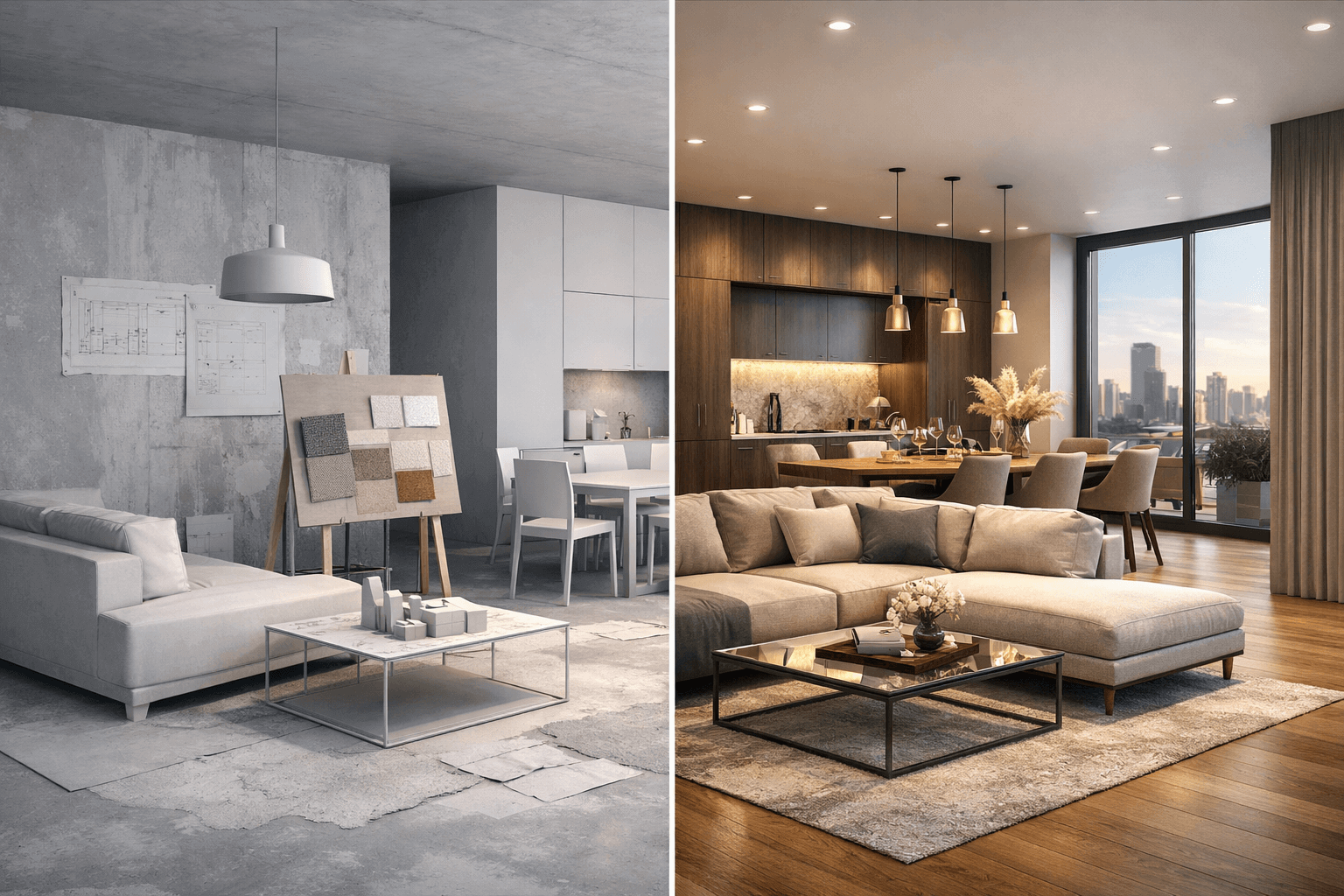
The real problem: people use the same word for two different tools
People often say “rendering” and “visualization” like they mean the same thing. In real projects, they don’t.
If you’re a developer, broker, designer, or marketing lead, this confusion costs time. You ask for one thing. The vendor delivers another. And then you’re stuck in revisions, missed deadlines, and a deck that doesn’t do its job.
Here’s what usually happens:
- A team asks for “interior visualization.” They actually need finished, photorealistic images for leasing or pre-sales.
- Or they ask for “interior rendering.” But they’re still deciding layout, finishes, and lighting. They needed a visual decision process, not polished final shots.
This matters because these deliverables sit in different parts of the workflow. They also cost different amounts and take different amounts of time.
And when the scope is unclear, three problems show up fast:
- Bad expectations. You think you’re buying marketing-ready images. You get something closer to a draft.
- Budget waste. You pay for photoreal quality before decisions are locked, so you pay again after changes.
- Deadline slip. Investor decks, listings, and internal approvals all depend on visuals. If the output is wrong, the timeline breaks.
This is also why picking the right 3d rendering services matters. Not because of “pretty images.” Because the studio should help you define what you need before anyone starts producing files.
What interior rendering actually is (in professional workflows)
Interior rendering is the production of final images that show a space as if it already exists.
In a professional workflow, interior rendering is used when key decisions are already made. You know the layout. You have a direction on materials. You’re not debating basic design choices every day.
Most teams use interior rendering for three reasons:
- Real estate marketing. Listings, pre-sales pages, brochures, email campaigns.
- Development communication. Showing stakeholders what will be built, with fewer “imagination gaps.”
- Design presentation. Presenting a near-final look to a client who needs confidence, not options.
A strong interior rendering is not just “a nice picture.” It’s a controlled visual asset. It answers practical questions people care about:
- How big does the room feel?
- Where does the light land?
- What do the finishes look like in real conditions?
- What’s the mood of the space?
What’s usually included in interior rendering
You’ll see different pipelines across studios, but high-quality interior rendering normally includes:
- Accurate modeling based on plans or a 3D model
- Materials and textures that match real products (or close equivalents)
- Lighting setup that feels believable (day/night if needed)
- Camera composition built for marketing, not just “a wide shot”
- Photoreal post-production (subtle, not overdone)
This is the point where 3D Interior Rendering Services make sense. You use them when you need visuals that can go straight into marketing, leasing, or investor materials with minimal explanation.
What interior visualization means in real business terms
Interior visualization is broader than rendering.
In real projects, “visualization” is the process of making design decisions visible. It helps teams align before they spend money on construction, changes, or final marketing assets.
Sometimes visualization includes photoreal renders. But often, it starts earlier. The goal is not “final beauty.” The goal is clarity.
Interior visualization can include:
- early concept views
- test scenes with rough materials
- alternate layouts or furniture plans
- lighting studies
- mood and style direction that supports a brand or target buyer
This is where a lot of teams save money, even if they don’t realize it. If you can validate direction early, you don’t keep redoing polished renders later.
So the simplest way to think about it is:
- Visualization is the system. It helps you decide what you’re building and how it should feel.
- Rendering is the tool. It produces the final images once decisions are locked.
If you’re still choosing finishes, layout, or tenant positioning, visualization comes first. If you’re already selling the space, interior rendering comes first.
Rendering vs Visualization: a practical comparison for real projects
Most teams don’t need a dictionary definition. They need to know what they’re buying and what it’s for.
Here’s the clean split.
| Aspect | Interior Rendering | Interior Visualization |
|---|---|---|
| Main goal | Show the final look | Help teams decide and align |
| Best for | Marketing, leasing, sales, investor decks | Design development, approvals, internal alignment |
| Timing | After key decisions are made | Throughout the project (especially early/mid) |
| Output | Final, photoreal images (often several angles) | A set of visuals that guide decisions (may include drafts, options, studies) |
| What it answers | “What will it look like?” | “What should it look like, and why?” |
| Risk if used wrong | Paying for final quality too early | Getting “nice concepts” that can’t be used in marketing |
A quick rule that works in practice:
- If you’re trying to sell or lease the space, you usually need interior rendering.
- If you’re trying to decide what the space should be, you usually need visualization.
And yes, there’s overlap. Some projects need both. But you still want to separate the goals. It keeps scope clean and prevents expensive rework.
When you need interior rendering – and when you don’t
You need interior rendering when the visuals will be used as a selling tool. Not just as an internal reference.
Common cases:
- Pre-sales and pre-leasing. You need buyers and tenants to “get it” fast.
- Listings and marketing collateral. Websites, brochures, email campaigns, ads.
- Investor decks. You can’t rely on floor plans alone if you want real confidence.
- Approvals and stakeholder alignment. Clear visuals reduce back-and-forth and subjective debates.
This is where professional 3d rendering services earn their keep. The images are not “art.” They are sales assets. They should be built to communicate scale, light, finishes, and use of space in a way a non-technical person can understand.
When you don’t need interior rendering:
- You’re still changing layouts every week.
- You’re still picking the finish direction.
- You want to explore options, not present a final answer.
In those cases, a “final look” will be wrong fast. And you’ll pay twice.
When visualization matters more than photorealism
Visualization is most valuable when decisions are still in motion. It helps you avoid polishing the wrong idea.
It matters most in these situations:
- Early-stage development. You have a plan, but the product story isn’t locked.
- Concept testing. You need to compare directions without committing to final detail.
- Tenant fit-out planning. You’re selling a future build-out, but the specifics depend on the tenant.
- Design approval loops. Too many stakeholders, too many opinions, not enough clarity.
This is the part many teams get wrong. They order “visualization,” get a few nice-looking scenes, and assume they’re ready for marketing.
But visualization without execution-quality output still falls flat when you need to convince buyers, tenants, or investors. Ideas are not enough if the visuals don’t feel real.
That’s why the right 3d rendering company matters even when you’re in a visualization phase. They should be able to scale the output from decision visuals to marketing-ready renders without changing the whole pipeline or starting from zero.
If the studio can’t do both, projects usually split into two vendors. That’s where quality and timelines often break.
Where most projects go wrong
Most problems aren’t about taste. They’re about timing, scope, and process.
Here are the patterns that keep showing up.
First, teams order the wrong thing.
They ask for “interior rendering” while the design is still moving. Layout changes, finish selections aren’t final, and the brand story isn’t locked. A week later, the images are outdated. Then it turns into revisions on top of revisions.
Or it goes the other way. They ask for “visualization,” but what they really need is marketing-ready output. They get draft-level scenes that work for internal discussion, but don’t hold up in a listing, brochure, or investor deck.
Second, they treat visuals like a simple deliverable.
They send a floor plan and say, “make it look good.” But there’s no finish direction, no reference set, no target buyer, no priority angles. So the vendor guesses. And guesswork is expensive.
Third, they split the work across too many hands.
One person models, another person renders, someone else does post. There’s no single standard. Small inconsistencies add up. The set looks “off,” even if each image is fine on its own.
This is why a real 3d rendering company matters. Not because “a company is better than a freelancer” by default. But because a good team runs a process. They ask for the right inputs. They flag gaps early. And they manage consistency across a full set, not one hero shot.
How professional studios combine both into one workflow
A clean workflow is simple. It moves from decisions to final output without restarting.
Most solid teams do it in three stages:
- Align on the goal and constraints
What is this for: pre-sales, leasing, design approval, investor deck?
What is fixed, and what is still open?
What level of realism is needed right now? - Build a “decision-ready” visual base
This is where visualization does the heavy lifting. You test layout, mood, key finishes, and lighting direction. The point is to reduce uncertainty before you spend time on final detail. - Lock direction, then produce final renders
Once choices are made, the studio pushes to final interior rendering. Same model, same scene logic, higher detail, refined materials, clean lighting, and consistent post.
This matters because most teams in the U.S. operate on tight cycles. Leasing deadlines don’t wait. Investor updates don’t wait. And design changes will happen anyway. A workflow that supports both visualization and final rendering keeps you from paying twice.
It also makes 3d rendering services more predictable. You’re not buying “a bunch of images.” You’re buying a process that gets you to usable assets with fewer surprises.
What to look for when hiring for interior projects
If you’re hiring for interior visuals, don’t start with “who has the nicest portfolio.” Start with “who can deliver what we need, on a real timeline, with fewer loops.”
Here’s what to check.
1) Real estate and marketing context
Ask how they build images for listings, pre-sales, or leasing. If they only talk about design style, that’s a gap. Marketing visuals need clear composition and a buyer-friendly viewpoint.
2) A clear input list
A good team can tell you what they need: plans, a model (if you have it), finish direction, reference images, brand cues, and required angles. If they don’t ask questions, they’ll guess.
3) Consistency across a set
Interior projects rarely need one image. They need a coherent package. Ask how they keep lighting, materials, and camera logic consistent across multiple rooms and angles.
4) Control of materials, light, and camera
This is where “looks real” comes from. Not from filters. If they can’t explain how they handle lighting scenarios and material matching, you’ll end up with images that feel generic.
5) Revision rules that protect the timeline
You want clarity: what counts as a revision, what counts as a scope change, and when feedback is due. Without this, projects drag.
If a team can handle these basics, you’re usually in good hands. And that’s what separates a generic vendor from a true 3d rendering company that delivers results.
Interior Rendering vs Interior Visualization: how to choose the right tool for your project
Rendering and visualization are not rivals. They solve different problems at different stages.
Visualization helps you think. It lets you test layouts, mood, light, and finish direction before anything is locked. It keeps teams aligned when ideas are still moving.
Rendering helps you sell. It turns those decisions into images that buyers, tenants, and investors can understand without explanation.
Most projects need both. The mistake is using one when you really need the other.
If you’re still shaping the product, start with visualization. If you’re already pitching, listing, or raising money, you need interior rendering that looks real and consistent across a full set.
That’s where 3D Interior Rendering Services come in. They turn design choices into assets you can use in marketing, leasing, and investor materials. Not concepts. Not drafts. Real visuals that do a job.
Your Journey | to Marketing Renders | That Bring Out | The Best in Your | Project
Read Our Whitepaper