
In modern development projects, most delays and disagreements don’t come from a lack of expertise. They come from a lack of shared understanding. Investors, developers, and architects often work with the same set of documents, yet interpret them in completely different ways.
Architectural drawings and technical plans are precise, but they are not intuitive. An architect may read a floor plan and immediately understand proportions, spatial flow, and intent. An investor, however, sees abstractions. A developer sees risk areas that are hard to explain to other stakeholders. As a result, discussions stall not because the idea is weak, but because the vision is unclear.
This disconnect becomes especially visible at early stages. Decisions about financing, scope, materials, or market positioning are made before construction begins, yet they rely heavily on imagination. When stakeholders are forced to “fill in the gaps” mentally, assumptions multiply. Each party forms a different picture of the final result, and alignment becomes fragile.
In practice, key decisions are rarely based on drawings alone. They are based on how clearly people can visualize the outcome. Without a shared visual reference, conversations drift into opinions, revisions increase, and confidence drops. This is why visual clarity is not a design luxury – it is a structural bottleneck in modern development workflows.
Architectural rendering addresses this gap by turning abstract plans into a concrete, shared vision. It allows all parties to evaluate the same outcome, rather than debating different interpretations of the same drawings.
Architectural Rendering as a Decision-Making Tool (Not a Presentation Asset)
Architectural rendering is often misunderstood as a presentation or marketing asset. In reality, its most important role is internal. It functions as a decision-making tool that supports alignment, validation, and risk control long before a project is marketed or built.
The first point of friction usually appears when drawings meet non-technical stakeholders. Plans and elevations communicate intent, but they require training to interpret accurately. Rendering bridges that gap by translating technical data into a visual format that reflects scale, context, materials, and atmosphere in a way that is immediately understandable.
Early visualization plays a critical role here. When design decisions are visualized early, potential issues surface sooner. Proportions that feel off, circulation problems, lighting conflicts, or material mismatches are easier to identify and discuss before they turn into costly revisions. This reduces downstream changes, which are often far more expensive once a project moves into later phases.
More importantly, rendering changes the nature of discussions. Instead of debating personal preferences or abstract ideas, stakeholders can evaluate concrete scenarios. Conversations shift from “I think” to “what happens if.” This shift improves the quality of feedback and leads to decisions that are based on shared evidence rather than subjective interpretation.
For companies that work with complex development pipelines, partnering with an experienced 3d rendering company is less about visuals and more about clarity. The goal is not to impress, but to make informed decisions faster and with greater confidence.
How Architectural Rendering Supports Investors
For investors, time and clarity are critical. Every project competes for attention, and decisions are often made under conditions of incomplete information. Architectural rendering helps reduce this uncertainty by providing a clear, visual framework for evaluation.
Faster Project Evaluation
Investors typically review multiple opportunities at once. Architectural renderings allow them to understand the scope, concept, and potential of a project quickly, without needing deep technical interpretation. A well-prepared rendering communicates scale, positioning, and overall vision in minutes rather than hours.
This efficiency matters. Faster evaluation means quicker internal discussions, more focused questions, and shorter decision cycles. Instead of spending time deciphering plans, investors can focus on strategic considerations such as feasibility, differentiation, and alignment with portfolio goals.
Risk Reduction at the Pre-Investment Stage
Early-stage investment carries inherent risk, much of it tied to uncertainty. Renderings reduce this uncertainty by making key design decisions visible before capital is committed. Layout choices, massing, façade treatment, and contextual fit can all be assessed visually.
This visual clarity limits subjective interpretation. When all stakeholders evaluate the same visual outcome, fewer assumptions are left unchallenged. Potential red flags are easier to spot, and expectations are set more accurately from the start. In this sense, rendering acts as a risk-filtering mechanism rather than a sales tool.
Investor Presentations and Capital Raising
In investor presentations, architectural rendering plays a supporting role rather than a persuasive one. Its value lies in credibility. Clear, realistic visuals demonstrate that a project has been thought through, not just financially, but spatially and operationally as well.
Renderings integrated into pitch materials help investors understand how the concept translates into a real asset. They support the narrative without exaggeration, reinforcing trust instead of relying on emotional appeal. This is particularly important when projects involve multiple funding rounds or external stakeholders who need consistent, reliable information.
At this stage, architectural rendering services are not about aesthetics alone. They are about providing a shared reference point that supports rational evaluation and informed investment decisions.
How Architectural Rendering Supports Developers
For developers, architectural rendering is primarily an operational tool. It helps align teams, reduce rework, and move projects through approvals and go-to-market stages with fewer surprises. Unlike investors, who use renderings to evaluate opportunity and risk, developers use them to manage execution across people, vendors, and timelines.
Aligning Vision Across Teams
Most development projects involve several groups that need to coordinate, but rarely share the same “language”: architects, internal project managers, general contractors, consultants, leasing teams, and marketing. Each group tends to focus on its own priorities, and misalignment often starts early, before anyone notices the divergence.
Rendering creates a single visual reference point that everyone can evaluate. It becomes a shared “source of truth” that reduces interpretation gaps between technical and non-technical stakeholders. When the team can see the same outcome, meetings become more concrete: scope is easier to confirm, key decisions are easier to document, and approvals are less dependent on subjective interpretation.
This alignment matters even more when multiple vendors are involved. A consistent visual target supports clearer briefs, fewer revisions, and more predictable handoffs between teams.
Pre-Sales and Market Validation
Renderings also support commercial decision-making before construction. For many projects, early leasing, pre-sales, or stakeholder buy-in depend on how clearly the product is communicated. Even a strong development concept can struggle if the market cannot understand what is being offered.
Architectural rendering helps developers validate positioning and demand earlier. It makes it easier to test assumptions about unit types, amenity packages, façade direction, and overall feel – without waiting for construction progress. When used correctly, renderings don’t “oversell” the project; they reduce uncertainty for buyers, tenants, brokers, and internal decision-makers.
This is where well-planned 3d rendering services can do more than produce images. They provide the visual clarity needed to support go-to-market readiness while the project is still flexible enough to adjust.
Reducing Costly Design Revisions
Design revisions are not all equal. A revision made early – before documents are finalized and procurement starts – usually costs time and coordination. A revision made later can multiply into change orders, delays, and budget overruns.
Rendering helps catch issues earlier because it reveals problems that are easy to miss in drawings. Spatial conflicts, scale perception, awkward circulation, weak daylighting assumptions, or material choices that do not work together become visible in a realistic context. This allows developers to identify potential issues when changes are still relatively cheap.
In practical terms, rendering reduces the probability of late-stage “reality checks”. Instead of discovering problems during construction or after stakeholder pushback, the team can validate key decisions upfront and move forward with greater confidence.
How Architectural Rendering Supports Architects
Architects already have the tools to design. The challenge is not producing plans – it is ensuring that the design intent is understood, approved, and protected throughout the project lifecycle. Architectural rendering supports this by translating concepts into visual language, strengthening approvals, and improving client communication.
Translating Concepts Into Clear Visual Language
Clients, investors, and many project stakeholders do not read drawings the way architects do. They may understand basic layouts, but they often struggle with scale, proportion, material relationships, and spatial atmosphere. This creates a common failure point: stakeholders agree to drawings they do not fully understand, and later react when the built result does not match their mental picture.
Rendering reduces this risk. It gives non-technical stakeholders a clear view of what is being proposed, allowing them to respond earlier and more accurately. It also reduces the volume of unproductive feedback, because discussions become grounded in a shared visual reference rather than vague descriptions.
Design Validation Before Approval
Rendering also supports design validation by making critical design decisions visible. Proportions, daylight behavior, material transitions, and visual hierarchy are easier to evaluate when the design is presented in context. This is particularly useful in projects with approval gates – whether internal, client-side, or regulatory – because it reduces back-and-forth caused by misunderstandings.
From a workflow perspective, rendering can act as an early diagnostic tool. It helps architects test design assumptions before documents are locked and supports more confident approvals because stakeholders can see what they are signing off on.
Stronger Client Communication
Clear communication is often the difference between a smooth project and a long, frustrating process. When expectations are not aligned, projects accumulate friction: clients request changes late, consultants interpret intent differently, and trust erodes.
Rendering strengthens communication by setting expectations visually and early. Clients can make decisions with more clarity, architects can document agreements more precisely, and teams spend less time revisiting old debates. It becomes easier to answer practical questions such as “what exactly are we approving”, “what will the façade feel like”, or “how will this space read in real conditions”.
The outcome is not just better visuals. It is a more stable decision process – and fewer moments where stakeholders say, “I thought it would look different”.
Rendering at Different Project Stages: Who Needs What and When
A common objection is, “It’s too early for rendering”. In most cases, the opposite is true. The earlier a project needs alignment and confident decision-making, the more valuable visualization becomes. What changes is not whether rendering is useful, but what type of rendering is appropriate at each stage.
Below is a practical view of how rendering supports different stakeholders across the project lifecycle:
| Project stage | Primary stakeholder need | What rendering supports |
|---|---|---|
| Concept stage | Investors, sponsors, internal leadership | Fast evaluation, early risk filtering, clarity of vision |
| Design development | Architects, consultants, client team | Design validation, alignment on materials and proportions, approval readiness |
| Pre-sales / approvals | Developers, marketing, leasing, external stakeholders | Communication to the market, faster buy-in, fewer late revisions |
At the concept stage, stakeholders need a clear visual narrative, not exhaustive detail. During design development, accuracy and material logic become more important because decisions are being finalized. At pre-sales and approvals, the priority is clarity and consistency – so the project can be communicated without creating unrealistic expectations.
This staged approach also improves efficiency. Instead of producing visuals that are “too much” or “too soon”, teams can match the level of detail to the decision that needs to be made. The goal is always the same: reduce ambiguity, align expectations, and support decisions before they become expensive to change.
Architectural Rendering vs Architectural Visualization: Context Matters
In the market, the terms architectural rendering and architectural visualization are often used interchangeably. That’s understandable, but it can also create confusion when stakeholders are trying to scope work, compare vendors, or align internally. The simplest way to think about the difference is this: rendering is a deliverable and a technique, while visualization is a broader category of communication that can include many deliverables.
Architectural rendering typically refers to producing still images (and sometimes animations) that depict a design in a realistic or stylized way. It’s a specific output that answers a practical question: what will this look like, in context, with materials and lighting? When stakeholders use renderings, they usually want to reduce ambiguity and make decisions faster – on massing, façade, interiors, or spatial feel.
Architectural visualization is a wider umbrella. It includes renderings, but can also cover 3D diagrams, axonometric views, 3D floor plans, interactive experiences, and virtual tours. The focus here is not only realism. It’s about communicating design intent clearly to a particular audience – investors, approvals, leasing teams, or end clients – using whatever visual format delivers clarity fastest.
For business stakeholders, the label matters less than the outcome. The practical questions are consistent:
- What decision needs to be made?
- Who needs to understand the design to make that decision?
- What format reduces misinterpretation and speeds alignment?
When teams frame the need around decisions rather than terminology, the scope becomes clearer, and the visuals become more effective. In other words, you don’t “buy rendering” or “buy visualization”. You choose the visual deliverables that support the decisions your project needs right now.
When Professional Architectural Rendering Becomes a Competitive Advantage
Not all renderings provide the same value. A rendering can look attractive and still fail as a decision tool if it hides important details, exaggerates the design, or creates misleading expectations. The difference between average and professional architectural rendering is rarely about “making it prettier”. It is about making it more reliable for business-critical decisions.
Professional renderings help stakeholders evaluate what actually matters: proportions, material logic, context, and spatial relationships. They reduce the risk of approval friction because the visual outcome aligns with real design intent. They also reduce the risk of late-stage disappointment because expectations are set early and accurately. That reliability is what creates a competitive advantage – especially in projects where decisions need to be made quickly and defended internally.
This advantage shows up in a few predictable ways:
- Speed of alignment. When visuals are clear and credible, stakeholders converge faster. Fewer meetings are spent explaining basics, and more time is spent making decisions.
- Higher quality feedback. Professional visuals make it easier to identify issues early. Stakeholders comment on what is real, not what they imagine.
- Better stakeholder confidence. Investors, partners, and internal decision-makers are more likely to support a project when the concept is communicated clearly and consistently.
In competitive markets, clarity is often a differentiator. A project that can be understood quickly tends to move faster through approvals, leasing conversations, and internal buy-in. Architectural rendering supports that clarity when it is approached as an accuracy and communication task – not an artistic one.
Choosing Architectural Rendering Services for Business-Critical Projects
When a project is tied to financing, approvals, leasing, or investor decisions, choosing a rendering vendor becomes a risk-management decision. The goal is not to find a studio that can produce nice images. The goal is to find a team that can deliver visuals that are accurate, consistent, and decision-ready.
Here are the criteria that tend to matter most in business-critical work.
Clarity of Scope and Deliverables
A serious vendor should help you define what you need, not just “take an order”. That includes confirming:
- what decisions the visuals will support (investment, approvals, leasing, stakeholder alignment)
- what level of detail is appropriate for the stage
- what formats are needed (still renderings, 3D floor plans, animation, virtual tours)
This is also where internal consistency matters. If you need a broader set of deliverables across teams and stages, it’s often more efficient to anchor the work through a clear services hub – your central page for 3d rendering services – and then route stakeholders to the specific deliverables they need from there.
Ability to Work With Real Project Constraints
Business projects rarely operate in ideal conditions. Timelines shift, design inputs evolve, and stakeholders request changes. Strong rendering partners handle this without creating chaos. Look for a process that covers:
- clean handoffs for CAD/BIM inputs and references
- structured revision rounds with clear assumptions
- predictable timelines tied to deliverable complexity
Business Context, Not Just Visual Output
A portfolio can look impressive and still be irrelevant to your case. What matters is whether the team understands why visuals are being produced. Vendors experienced in developer and investor-facing projects tend to ask better questions and produce assets that support decisions, not just aesthetics.
If you’re comparing options, focus on how the team thinks, not only what they show. The right partner will treat rendering as part of your project workflow, and will understand that credibility is more important than dramatic effects.
And if you need a baseline to evaluate vendors against, it helps to look at how a credible 3d rendering company structures its process, deliverables, and expectations – because that’s usually where decision-ready work starts.
Rendering as a Business Tool, Not a Visual Add-On
Across investors, developers, and architects, one pattern is consistent: problems arise when decisions are made without shared clarity. Architectural rendering exists to solve exactly this issue. It is not a decorative layer added at the end of the process, and it is not a marketing shortcut. It is a business tool that supports alignment, reduces uncertainty, and speeds up decision-making.
For investors, rendering enables faster and more confident evaluation by turning abstract concepts into tangible outcomes. For developers, it aligns teams, supports pre-sales and approvals, and reduces costly revisions by surfacing issues early. For architects, it protects design intent, improves communication, and ensures approvals are based on a real understanding of the proposed solution.
When used correctly, architectural rendering changes how projects move forward. Decisions become clearer. Conversations become more focused. Risks are identified earlier, when they are cheaper to address. The result is not just better visuals, but more efficient projects with fewer surprises.
The key distinction is mindset. Rendering delivers value when it is treated as part of the decision-making infrastructure of a project, not as an afterthought or a visual upgrade. In complex, high-stakes development environments, clarity is a competitive advantage – and architectural rendering is one of the most practical ways to achieve it.
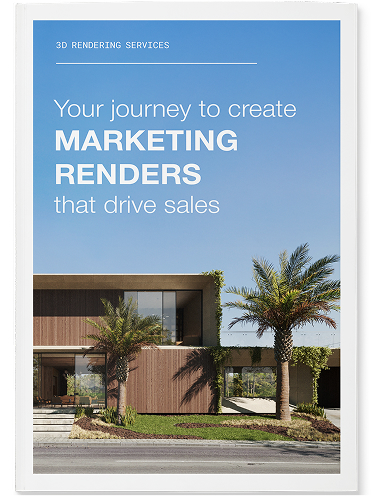
Your Journey | to Marketing Renders | That Bring Out | The Best in Your | Project
Read Our Whitepaper